
Apple Intelligence in 2026: Which Features Run On-Device and Which Depend on the Cloud
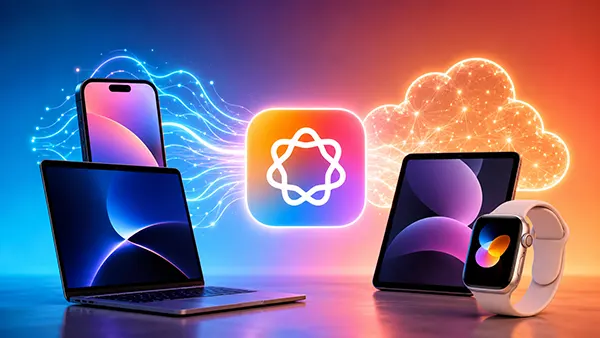
Apple Intelligence has become a central part of the Apple ecosystem by 2026, extending across iPhone, iPad, Mac and selected Vision devices. Unlike many AI systems that rely entirely on remote servers, Apple combines local processing with cloud-based computing to balance privacy, speed and advanced functionality. This hybrid approach allows users to benefit from artificial intelligence without sending every request to external data centres. Understanding which features run directly on a device and which require cloud resources helps explain how Apple delivers both security and performance.
How Apple Intelligence Uses On-Device Processing
Many everyday Apple Intelligence tasks are processed directly on supported devices equipped with Apple Silicon. Features such as notification summaries, writing assistance suggestions, text rewriting, grammar corrections and intelligent prioritisation of messages can operate locally because modern Apple chips include dedicated Neural Engine hardware. Running these tasks on-device reduces latency and keeps personal information under the user’s control.
Siri has also gained stronger local capabilities. In 2026, the assistant can understand conversational context across multiple requests, perform app-related actions and manage device settings without contacting external servers for every command. Local processing allows Siri to respond more quickly while maintaining access to personal data stored on the device.
Photo management is another area where on-device AI plays a major role. Image categorisation, object recognition, duplicate detection and semantic search within photo libraries can be performed locally. Users can search for people, locations, pets or specific objects while sensitive image data remains stored on their own hardware.
Benefits of Local AI Processing
Privacy remains the most significant advantage of on-device intelligence. When data does not leave the device, the risk of exposure through external transmission is reduced. Apple continues to emphasise this approach as a key differentiator compared with AI services that depend entirely on remote infrastructure.
Local execution also improves responsiveness. Tasks such as summarising a message, generating quick text suggestions or searching through personal content can often be completed instantly because there is no need to wait for network communication.
Another benefit is availability. Many Apple Intelligence features continue functioning even when internet connectivity is limited or unavailable. This is particularly useful during travel, in areas with poor coverage or when users deliberately disable mobile data connections.
Features That Require Apple’s Cloud Infrastructure
Not every AI task can be handled efficiently by a smartphone, tablet or laptop. More complex requests often require significantly larger language models and computing resources than those available on local hardware. For these situations, Apple uses Private Cloud Compute, a system designed to extend processing capabilities while maintaining privacy protections.
Advanced content generation is one example. When users request detailed document creation, complex reasoning tasks, extensive data analysis or multi-step content transformations, Apple Intelligence may send relevant information to secure cloud systems for processing. These models can handle workloads that exceed the capacity of local devices.
Certain image generation and advanced visual creation tools also rely on cloud resources. Producing highly detailed AI-generated graphics, editing large visual projects or performing sophisticated creative tasks often requires access to larger computational environments than those available on consumer devices.
Private Cloud Compute and User Privacy
Apple introduced Private Cloud Compute to address concerns about AI-related privacy. According to Apple’s architecture, only the information necessary to fulfil a request is processed, and user data is not retained for model training after the task is completed.
The company has also made parts of its cloud infrastructure available for independent security review. This approach allows researchers to inspect security mechanisms and verify that privacy claims align with the actual implementation.
For users, the transition between local and cloud processing is designed to remain largely invisible. Apple Intelligence automatically determines where a task should be executed based on complexity, resource requirements and the capabilities of the device being used.
The Future Balance Between Device and Cloud AI
As Apple Silicon continues to evolve, more AI features are expected to move from the cloud to local hardware. Each new generation of processors delivers greater Neural Engine performance, allowing increasingly sophisticated models to run directly on consumer devices.
At the same time, cloud computing will remain important for demanding workloads. Large-scale reasoning, advanced generative AI systems and resource-intensive creative tools will continue to benefit from server-based processing. Rather than replacing local intelligence, cloud infrastructure is likely to complement it.
Developers are already adapting applications to take advantage of this hybrid architecture. Software creators can use Apple Intelligence frameworks to determine whether tasks should be executed locally or through approved cloud resources, helping optimise both performance and privacy.
What Users Can Expect Beyond 2026
Future versions of Apple Intelligence are likely to deliver stronger personalisation while preserving user control over data. Improvements in hardware efficiency may enable larger language models to run directly on devices that currently depend on cloud support.
Cross-device intelligence is also expected to become more advanced. Apple’s ecosystem already allows information to flow between iPhone, iPad and Mac, and future developments may create more seamless AI experiences that understand context across multiple devices.
The long-term direction appears clear: Apple intends to keep as much processing as possible on user hardware while using secure cloud resources only when necessary. This strategy combines the advantages of privacy-focused computing with the capabilities required for increasingly sophisticated artificial intelligence features.